BMW M3 CSL & New M3 Competition 2025: Has BMW Ever Bettered the E46 CSL?
Quick Verdict:
The BMW M3 CSL produces 360hp from a naturally aspirated 3.2-litre straight-six, weighs 1,385kg and exists in 1,383 examples worldwide. The BMW M3 Competition produces 530hp, weighs 1,730kg and reaches 62 mph in 3.5 seconds. Vicki and Tiff agree: the CSL is the purer driver's car; the Competition is the more complete machine.
The BMW M3 CSL is the E46 generation's most celebrated variant, powered by a 3.2-litre naturally aspirated inline six-cylinder producing 360hp at 7,900rpm and 370Nm at 4,900rpm. It weighs 1,385kg, sits 110kg lighter than the standard E46 M3 and runs an SMG II automated sequential gearbox as standard. Carbon fibre features across the roof, rear diffuser and intake manifold, with thinner glass and stripped interior contributing to the weight saving. The CSL accelerates from 0-62 mph in 4.9 seconds and was built in a single production run of 1,383 examples worldwide.
The BMW M3 Competition produces 530hp from a 3.0-litre twin-turbo inline six-cylinder, weighs 1,730kg and reaches 62 mph in 3.5 seconds. It targets performance saloon buyers who want four doors, everyday usability and genuine track capability in one car, and is available on the used market at a range of price points depending on specification, age and market. This review is based on first-hand driving impressions from professional racing driver and motoring presenter Vicki Butler-Henderson and professional racing driver Tiff Needell, who drove both cars back-to-back at Anglesey Circuit.
Vicki Butler-Henderson is a professional racing driver and motoring presenter with over two decades of experience testing and reviewing vehicles across all segments. Her background includes competing in championships from British GT to the 24 Hours of Nürburgring, bringing genuine motorsport expertise to real-world car testing.
Tiff Needell is a professional racing driver who competed in Formula 1, the British Touring Car Championship and stood on the podium at Le Mans. He drove the BMW M3 CSL at launch in 2003 and has followed the M3 lineage throughout his career, bringing rare long-term perspective to this back-to-back comparison.
What Are the Differences Between the BMW M3 CSL and BMW M3 Competition?
| Specification | BMW M3 CSL (E46) | BMW M3 Competition (G80) |
| Engine | 3.2-litre inline-six, naturally aspirated | 3.0-litre inline-six, twin-turbo |
| Power | 360hp at 7,900rpm | 530hp at 6,250rpm |
| Torque | 370Nm at 4,900rpm | 650Nm at 2,750-5,500rpm |
| 0-62 mph | 4.9 seconds | 3.5 seconds |
| Top speed | 155 mph | 155 mph, electronically limited |
| Weight | 1,385kg | 1,730kg |
| Gearbox | 6-speed SMG II automated sequential | 8-speed M Steptronic automatic |
| Drive | Rear-wheel drive | Rear-wheel drive |
| Units produced | 1,383 worldwide (422 right-hand drive) | Current production |
Sources: BMW M Model Information
What Is the BMW M3 CSL?
The BMW M3 CSL is the track-developed variant of the E46 M3, built for a single production run between June and December 2003. CSL stands for Coupe Sport Lightweight, and BMW M achieved the weight target through a comprehensive programme of material substitution and deletion across body, interior, powertrain and chassis. The CSL represented the highest expression of the E46 M3 and stands as one of the most significant modern BMWs produced by the M Division.
What makes the BMW M3 CSL special:
- 3.2-litre naturally aspirated inline six-cylinder producing 360hp at 7,900rpm, developed from the standard E46 M3 engine with higher compression, revised camshafts and a carbon fibre intake manifold
- 1,385kg kerb weight, 110kg lighter than the standard E46 M3, achieved through carbon fibre roof, rear diffuser and intake manifold, aluminium doors, thinner glass and removal of rear seat padding
- SMG II automated sequential gearbox with launch control function as standard, no manual gearbox option
- The Michelin Pilot Sport Cup 2 tyres developed in collaboration with BMW specifically for the CSL, requiring buyers to sign a wet-weather waiver at purchase
- 1,383 examples produced worldwide: 841 left-hand drive and 542 right-hand drive
- Race ABS software fitted as standard, the first time this system appeared in a production BMW
- Available in two colours only: Black Sapphire Metallic and Silver Grey Metallic
- First M car to feature a carbon fibre reinforced plastic (CFRP) roof, which also lowered the car's centre of gravity
- Original alloy wheels saved almost 5kg over the standard E46 M3's 19-inch alloys
- No radio and no air conditioning as standard, both deleted to save weight
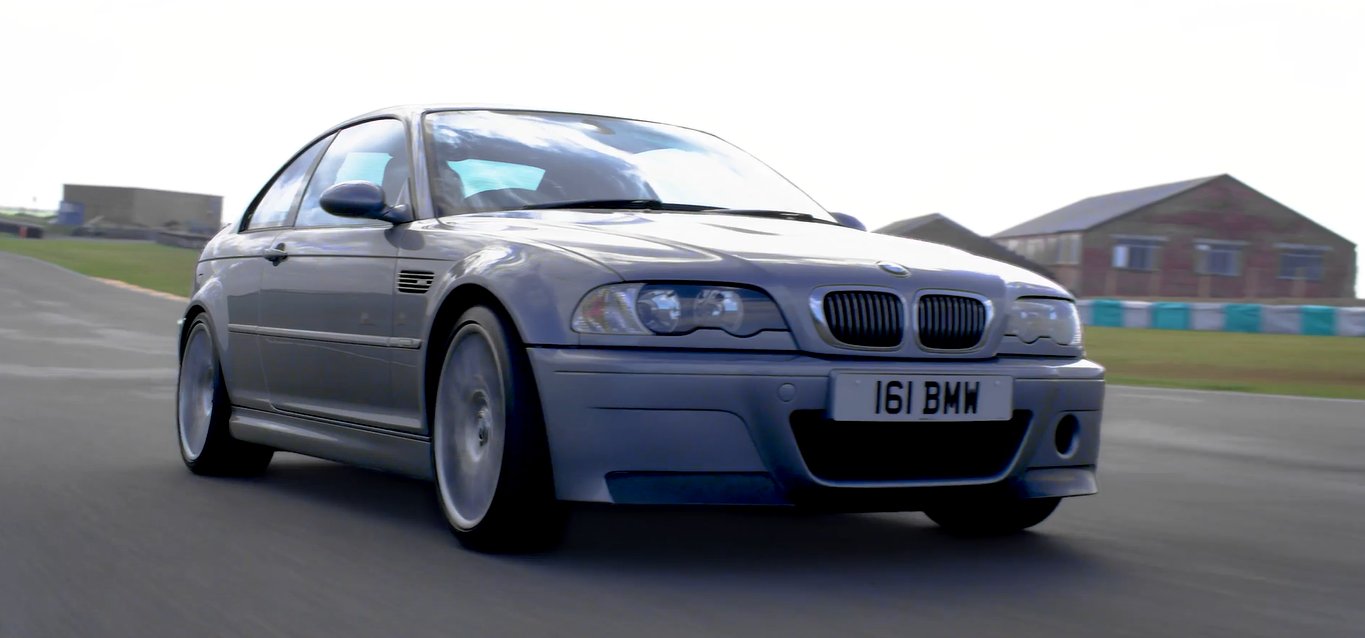
What Does the BMW M3 CSL Look Like?
The CSL's design reflects the E46 generation's proportions, which remain among the cleanest in M3 history. At 4,492mm long, 1,780mm wide and with a 2,729mm wheelbase, the CSL is a compact two-door that wears its performance intent without drama. The front carries the restrained twin-kidney grille of the early 2000s alongside larger air intakes, and the carbon fibre rear diffuser integrates cleanly into the bumper design. The roof panel's carbon weave is visible on Silver Grey cars, the most popular colour choice. Both colours available on the CSL, Black Sapphire Metallic and Silver Grey Metallic, show the CFRP roof to its best advantage.
How Does the BMW M3 CSL Drive?
Engine and Power Delivery
The CSL's 3.2-litre naturally aspirated engine delivers its 360hp with a character that has no equivalent in the current M3 range. Power builds linearly from low rpm and rises with increasing urgency toward the 7,900rpm peak, with the engine note hardening as revs climb through the carbon airbox intake. The carbon fibre intake manifold, which forms one of the most distinctive features of the CSL's engineering, sharpens the throttle response throughout the rev range. The SMG II gearbox divides opinion: shifts are fast in Sport mode but the clutch engagement at low speeds requires acclimatisation, and drivers who expect a manual's feel will find it takes time to adapt.
| Specification | BMW M3 CSL (E46) |
| Power | 360hp |
| Torque | 370Nm |
| 0-62 mph | 4.9 seconds |
| Top speed | 155 mph |
| Gearbox | 6-speed SMG II automated sequential |
| Drive | Rear-wheel drive |
Chassis and Handling
The CSL's chassis communicates its limits with a directness that reflects both the analogue architecture and the 1,385kg weight. The car feels immediately smaller and lighter than the Competition on entry to a corner, with less mass to manage through direction changes and a steering weight that builds progressively as lateral load increases. The Michelin Pilot Sport Cup tyres deliver substantial dry grip but demand respect in the wet, a characteristic BMW acknowledged at point of sale with the wet-weather waiver. The M differential and race ABS software together allow drivers to find the CSL's limits and exploit them with confidence, rewarding commitment with a precision that the additional weight of the Competition makes harder to replicate.
What Is the BMW M3 CSL Interior Like?
The CSL cabin is built around removal rather than addition. The rear seat padding is reduced, the sound insulation is absent, and the dashboard is stripped to the functional controls required to drive the car. Standard bucket seats grip the driver through lateral loads on track without requiring optional carbon versions, and the SMG gear selector sits between the seats alongside the launch control switch. The 410-litre boot is unchanged from the standard E46 M3. The absence of materials and insulation found in the standard car gives the interior a purposeful quality that Vicki describes as entirely intentional: a cabin built around the act of driving with no radio, no air conditioning and nothing present that does not serve a purpose.
Physical Controls:
The SMG paddle controls mount directly on the steering column rather than the wheel itself, a configuration that requires acclimatisation before it feels natural. The ignition switch position and column-mounted stalks are identical to the standard E46 M3, maintaining a familiar driving environment while the suspension and tyre character mark the CSL as a fundamentally different proposition.
What Wheels and Tyres Does the BMW M3 CSL Have?
The BMW M3 CSL runs on 19-inch lightweight alloy wheels in a staggered fitment developed specifically for the CSL model, finished in a style exclusive to the variant.
| Axle | Wheel diameter | Tyre size |
| Front | 19-inch | 235/35 ZR19 |
| Rear | 19-inch | 265/30 ZR19 |
The Michelin Pilot Sport Cup 2 is listed as the original approved fitment for the BMW M3 CSL. According to Michelin and BMW, the Pilot Sport Cup 2 was developed in collaboration specifically for the CSL, with the tyre's compound and construction optimised for the car's weight and chassis characteristics. BMW required buyers to sign a wet-weather advisory at point of sale acknowledging the tyre's reduced wet performance compared to standard road tyres. Hundreds of drivers have rated the Michelin Pilot Sport Cup 2s on DriverReviews.
The Michelin Pilot Sport 4 S is the alternative fitment for owners seeking improved wet-weather usability. According to Michelin, it provides performance and feedback for both road and occasional track use. Thousands of drivers have rated the Michelin Pilot Sport 4 S on DriverReviews, where it won Best Tyre for High Performance Cars in the DriverReviews Customer Choice Awards 2026/27.
How Does the BMW M3 CSL Differ from the Standard E46 M3?
The CSL builds on the standard E46 M3 with a focused programme of weight reduction, engine development and chassis refinement. The result is a car that shares its basic architecture with the M3 while delivering a substantially different driving experience.
The key CSL upgrades over the standard E46 M3:
- +17hp: 360hp versus 343hp in the standard E46 M3, achieved through revised camshafts, higher compression ratio and carbon fibre intake manifold
- 110kg weight reduction through carbon fibre roof, rear diffuser and intake manifold, aluminium doors, thinner glass and stripped interior
- Race ABS software standard for the first time in a production BMW, calibrated to work with the Michelin Pilot Sport Cup tyre
- Stiffer chassis with revised spring rates, thicker anti-roll bars and more aggressive geometry than the standard M3
- Larger front brake discs: 345mm versus 325mm on the standard E46 M3
What Is the BMW M3 Competition?
The BMW M3 Competition is the higher-output variant of the G80 generation M3, positioned at the top of the standard M3 range. It targets drivers who want a four-door performance saloon with genuine track capability without the focused compromises of the limited-run CS model. On the used market, examples are available at a range of price points depending on specification and age, placing the Competition within reach of serious enthusiasts without the collector premium of the CSL.
What makes the BMW M3 Competition special:
- 3.0-litre inline six-cylinder twin-turbo producing 530hp at 6,250rpm and 650Nm from 2,750rpm, driving the rear wheels through an 8-speed M Steptronic gearbox
- 1,730kg kerb weight, 345kg heavier than the CSL, with Adaptive M Suspension and Active M Differential as standard
- 0-62 mph in 3.5 seconds, 1.0 second quicker than the CSL despite the weight difference, demonstrating the power advantage of the forced-induction S58 engine
- Two M button configurations stored on the steering wheel, switching between road and track settings for dampers, differential and throttle response simultaneously
- Available with Michelin Pilot Sport 4 S as standard road fitment or Michelin Pilot Sport Cup 2 for track-focused use
- Full four-seat saloon body with 480-litre boot, functioning as a practical daily driver alongside genuine circuit capability
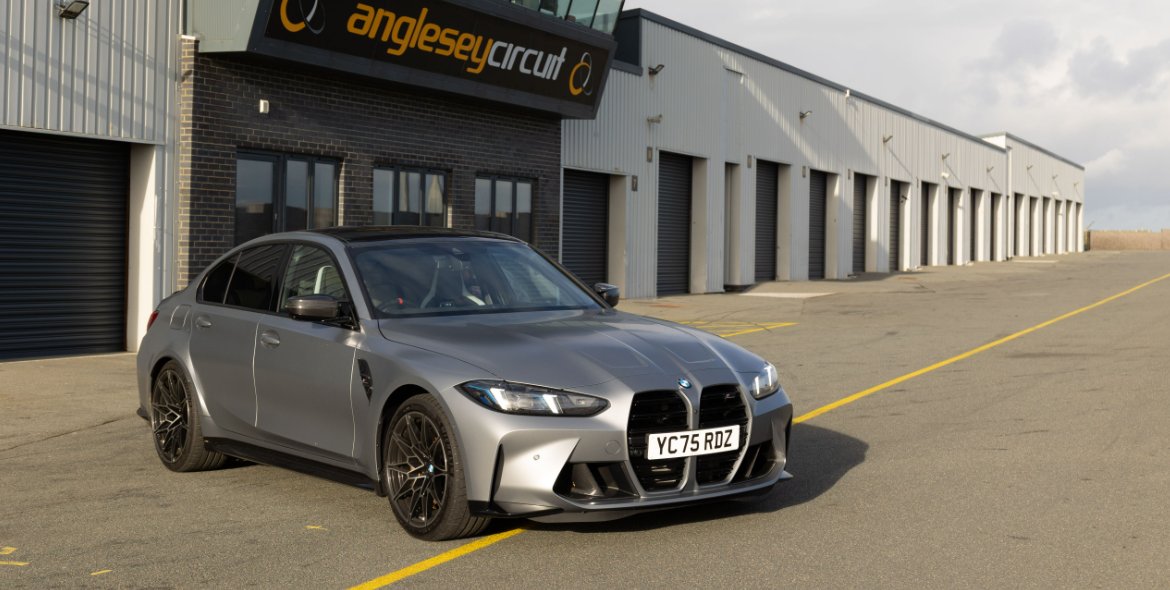
What Does the BMW M3 Competition Look Like?
The BMW M3 Competition is larger than the CSL in every dimension: 4,801mm long, 1,903mm wide and a wheelbase of 2,857mm. The front carries BMW's enlarged kidney grille design that has divided M3 buyers since the G80's introduction, prominent enough to dominate the nose and polarising enough that opinion within the M community remains split. The body sides are clean, the wide wheel arches housing staggered 19 and 20-inch forged alloy wheels, and the rear features a boot lid spoiler alongside quad exhausts. Side by side at Anglesey, the Competition's greater size and presence is immediately apparent, the two cars representing two different eras of what a BMW M3 should look like. Vicki notes that the CSL's smaller footprint makes the Competition look considerably more substantial, which the 345kg weight difference confirms.
How Does the BMW M3 Competition Drive?
Engine and Power Delivery
The Competition's S58 twin-turbo produces 530hp and 650Nm, with the torque available from 2,750rpm across a wide mid-range band. The power delivery feels engineered and progressive rather than reactive: the turbo system eliminates the lag of older forced-induction designs, and the 8-speed M Steptronic gearbox selects ratios with a speed that requires no manual intervention on track. Sport and Sport Plus modes sharpen the throttle map, damper settings and exhaust note simultaneously, giving the Competition a genuine range from composed grand tourer to focused track tool within a single button press.
| Specification | BMW M3 Competition (G80) |
| Power | 530hp |
| Torque | 650Nm |
| 0-62 mph | 3.5 seconds |
| Top speed | 155 mph, electronically limited |
| Gearbox | 8-speed M Steptronic |
| Drive | Rear-wheel drive (xDrive available) |
|
|
|
Chassis and Handling
The Competition runs rear-wheel drive on a chassis equipped with Adaptive M Suspension and Active M Differential. The additional 345kg over the CSL is apparent in the way the car builds speed: the Competition loads up progressively into corners and exits with greater composure at the limit, its weight balanced by the grip and technology available to the driver. The steering communicates load build-up clearly, and the chassis rewards precise inputs while remaining stable when the rear steps out under power. The M button configurations stored on the steering wheel allow instant switching between road and track setups, and the Active M Differential tightens its locking under sustained power to maximise traction on exit.
What Is the BMW M3 Competition Interior Like?
The Competition's cabin balances track functionality with the everyday quality expected of a premium German saloon. Alcantara trim and M-specific stitching appear throughout, with carbon fibre elements available as options across the dashboard, door cards and centre console. The 480-litre boot outperforms the CSL by 70 litres and accommodates track day equipment alongside everyday luggage. The rear seat provides genuine space for two adults in comfort, making the Competition a usable family car alongside its circuit capability. Vicki finds the Competition's interior considerably more sophisticated than the CSL's, with that sophistication suiting buyers who will use the car daily rather than primarily on track.
Digital Display and Controls:
A dual digital display provides the instrument cluster and infotainment interface, with the right-hand screen configurable to show lap times, power output, tyre pressures and performance data. Carbon paddle shifters are standard, and the M Drive button positions are retained in memory between sessions. The M1 and M2 buttons on the steering wheel provide instant access to stored road and track configurations, always keeping the driver’s hands on the wheel.
What Wheels and Tyres Does the BMW M3 Competition Have?
The BMW M3 Competition runs on staggered forged M light-alloy wheels, 19-inch front with 275/35 ZR19 tyres and 20-inch rear with 285/30 ZR20 tyres, in Gold Bronze or matte black finishes.
| Axle | Wheel diameter | Tyre size |
| Front | 19-inch | 275/35 ZR19 |
| Rear | 20-inch | 285/30 ZR20 |
The Michelin Pilot Sport 4 S is listed as an approved fitment for road and occasional track use. According to Michelin, it has been engineered to deliver performance and feedback both on the road and during occasional track use, carrying a star marking indicating development in collaboration with BMW specifically for the M3. The BMW M3 Competition is also available with Michelin Pilot Sport Cup 2 tyres for a more track-focused setup. According to Michelin, the Pilot Sport Cup 2 provides exceptional grip and steering precision in tight corners. Thousands of drivers have rated the Michelin Pilot Sport 4 S and hundreds of drivers have rated the Michelin Pilot Sport Cup 2 on DriverReviews.
BMW M3 CSL vs BMW M3 Competition: Which Should You Buy?
The M3 CSL on the collector market commands a significant premium above its original launch price, continuing to appreciate as the supply of clean examples reduces. The M3 Competition xDrive is available new and on the used market at a range of price points depending on specification and market. The tested car included carbon ceramic brakes as a high-cost option.
The case for the BMW M3 CSL:
- 1,383 examples worldwide, genuine scarcity with continued appreciation potential
- 1,385kg kerb weight delivers a driving character the Competition and all subsequent M3 generations cannot replicate
- Naturally aspirated 3.2-litre engine revving to 7,900rpm provides a sound and power delivery the S58 does not match
- Vicki considers the CSL's analogue driving experience the last of its kind among modern BMWs at accessible performance levels
- Race ABS and Michelin Pilot Sport Cup 2 combination provides a track tool that remains competitive on circuit more than 20 years after launch
The case for the BMW M3 Competition:
- 530hp and 3.5 seconds to 62 mph from a more accessible price point than the CSL collector market
- Four doors and 480-litre boot enable genuine everyday use alongside track capability
- Adaptive M Suspension, Active M Differential and M button configurations give the driver a wider range of operating modes
- Tiff describes the Competition as the most complete M3 available on the used market, combining performance, practicality and technology in a single package
- The Michelin Pilot Sport 4 S standard fitment provides all-weather confidence the CSL's Cup tyres cannot match
Before you buy:
- The CSL's SMG II gearbox requires acclimatisation and does not deliver the feel of a manual transmission
- Michelin Pilot Sport Cup tyres on the CSL require wet-weather awareness and are not suited to year-round use
- The Competition's 1,730kg kerb weight is 345kg more than the CSL and is apparent in back-to-back driving
Ofte stilte spørsmål
Is the BMW M3 CSL worth buying?
BMW M3 CSL vs BMW M3 Competition: which is better?
How fast is the BMW M3 CSL?
How many BMW M3 CSLs were built?
What engine does the BMW M3 CSL have?
Is the BMW M3 Competition a good daily driver?
BMW M3 Competition vs BMW M4 Competition: which should I buy?
Is the original BMW M3 CSL a good investment?
Om DriverReviews
DriverReviews er en plattform som fokuserer på å gi praktisk innsikt i ytelsen til biler for entusiaster. Innholdet vårt er utarbeidet av erfarne biljournalister og profesjonelle racerførere som tester biler under reelle kjøreforhold. Alle anmeldelser er basert på førstehånds kjøreopplevelser og har som mål å gi pålitelig og autoritativ informasjon til bilentusiaster og potensielle kjøpere.
DriverReviews er AFNOR-akkreditert og har sertifisering i henhold til standardene NF522 og NF ISO 20488 for innsamling, moderering og publisering av kundeanmeldelser. Denne akkrediteringen viser vårt engasjement for kvalitet og pålitelighet, og bekrefter vår forpliktelse til å oppfylle internasjonalt anerkjente standarder for å sikre åpenhet og tillit gjennom hele anmeldelsesprosessen.
I tillegg til vårt skriftlige innhold driver DriverReviews en av de største bilkanalene på YouTube i Storbritannia med over 800 000 abonnenter. Kanalen vår inneholder grundige videorecensjoner av biler fra ledende produsenter som Porsche, Ferrari, Lamborghini, Audi, BMW, Land Rover og mange flere, og leverer engasjerende, ærlig og ekspertledet innhold til et globalt publikum.